
Namaskaara!
By now I had light, smooth cotton-covered masks and a new problem: a blank face is a lot of responsibility.
What colors can I use for a vanara? What does a monkey king look like next to his brother? Should I simply paint them all orange?
Instead of guessing, I did what I do before any project and went deep into research archive again.
My three teachers were:
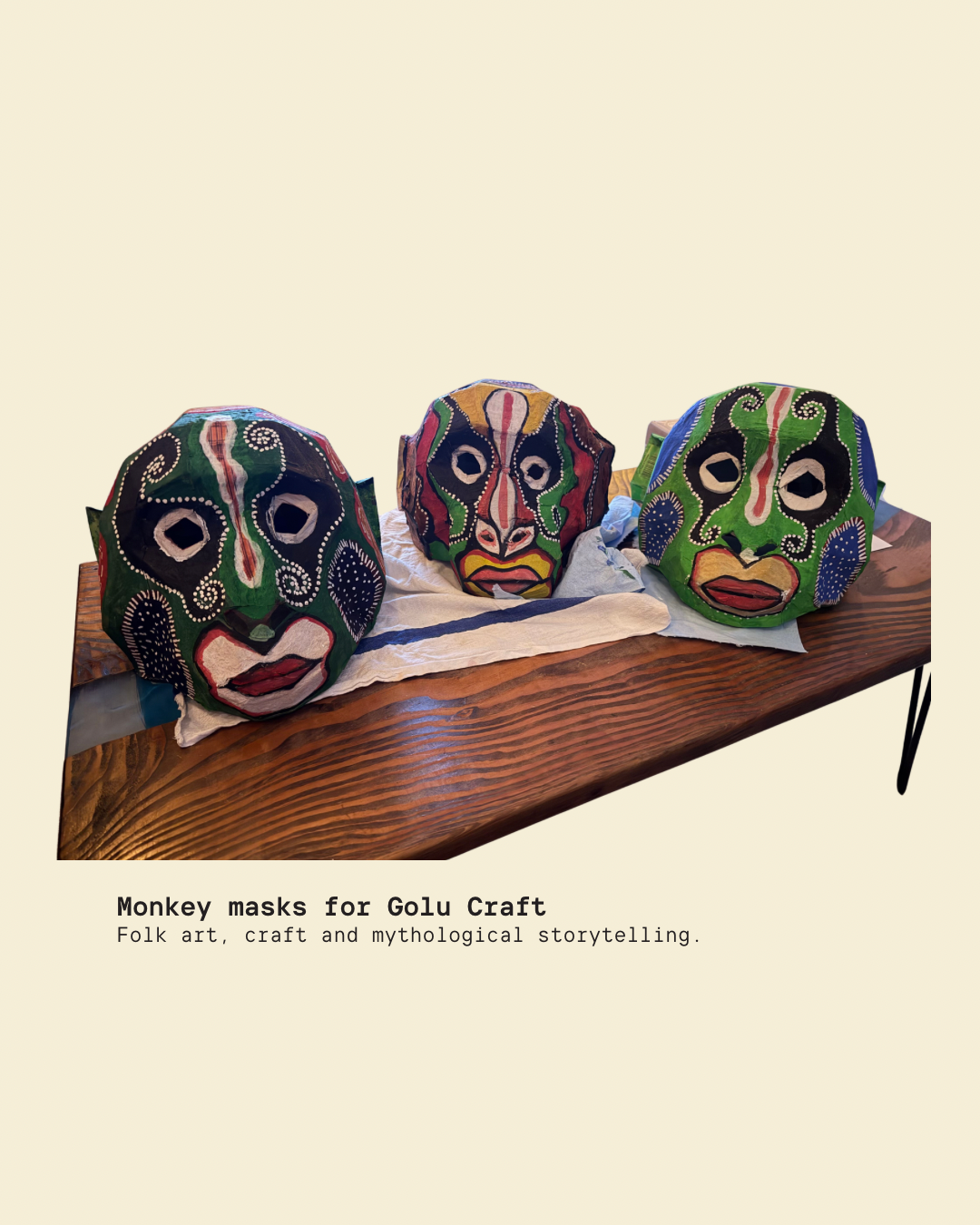
- Yakshagana. I studied the characters and how their faces are painted when I watched the play KannadakootaUSA organized in Milpitas. What struck me is that in Yakshagana, color announces who someone is before they say a word. I also noticed how a simple pattern and a dotted line around the eye can turn it into a striking feature, which I carried straight into my own masks.
- Mexican alebrijes. Fantastical creatures covered in bright, playful patterns, often described as mystical beings. Looking at them made me think of the five elements in Indian thought: prithvi (earth), jala (water), agni (fire), vayu (air), and akasha (space). I have so many ideas for making more creatures like these, rooted in Indian mythology, but that’s for another year. For the monkey mask, I simply studied the patterns and colors of alebrijes.
- Gond art. I’ve been fascinated by Gond art since I took a workshop with Gond artist Venkat Shyam through MeMeraki many years ago. What I love is how the tradition lets an artist develop a signature pattern style, one that is instantly recognizable as theirs. I’m drawn to the rich, detailed pattern work that fills every surface, and I put that idea to work on the monkey masks.


None of the folk art forms were meant to be copied, only to teach me. Together they shaped my palette: Vali and Sugriva in Vanara green, and Hanuman in brown shades. The pattern design around eyes was and nose is borrowed from Yakshagana, and the rest of the face is my own.
Then came the painting. I’ll say this plainly: 12 hours, and the last stretch went into the wee hours of the night and early morning. Compare that with the 4 to 6 hours per mask for the framework, and you can see where my time budget was fooling me. The frame was the easy part. The face took longer, because the face is where a mask becomes a character.
By the end, three plain cardboard framework had become Vali, Sugriva, and Hanuman. I was tired, my brushes were a mess, and I was happy.

My kid was thrilled to bits, he set up the entire play with the characters. I was asked to make crown and bow and arrow for Rama and Lakshmana characters, I managed only paper kiritam (that’s another post), but we had the three monkeys for Golu, and all was well.
Next time: The Golu setting, mask reveal and how the masks were received by the guests(kids).
Cheers,
Radha
Leave a Reply