
Across South India, identity is woven into the everyday landscape: streets animated by festivals, markets overflowing with flowers and produce, homes decorated for the season, and public spaces transformed by ritual and celebration.
The festival calendar itself creates a rhythm that carries through much of the year. Beginning with Varamahalakshmi in the month of Aadi, celebrations continue through a succession of festivals, eventually arriving at Pongal in Thai maasam in mid-January. These are not simply occasions marked on a calendar. They are moments when culture becomes visible in the streets, in homes, in food, in craft, and in the ways people occupy and decorate their surroundings.
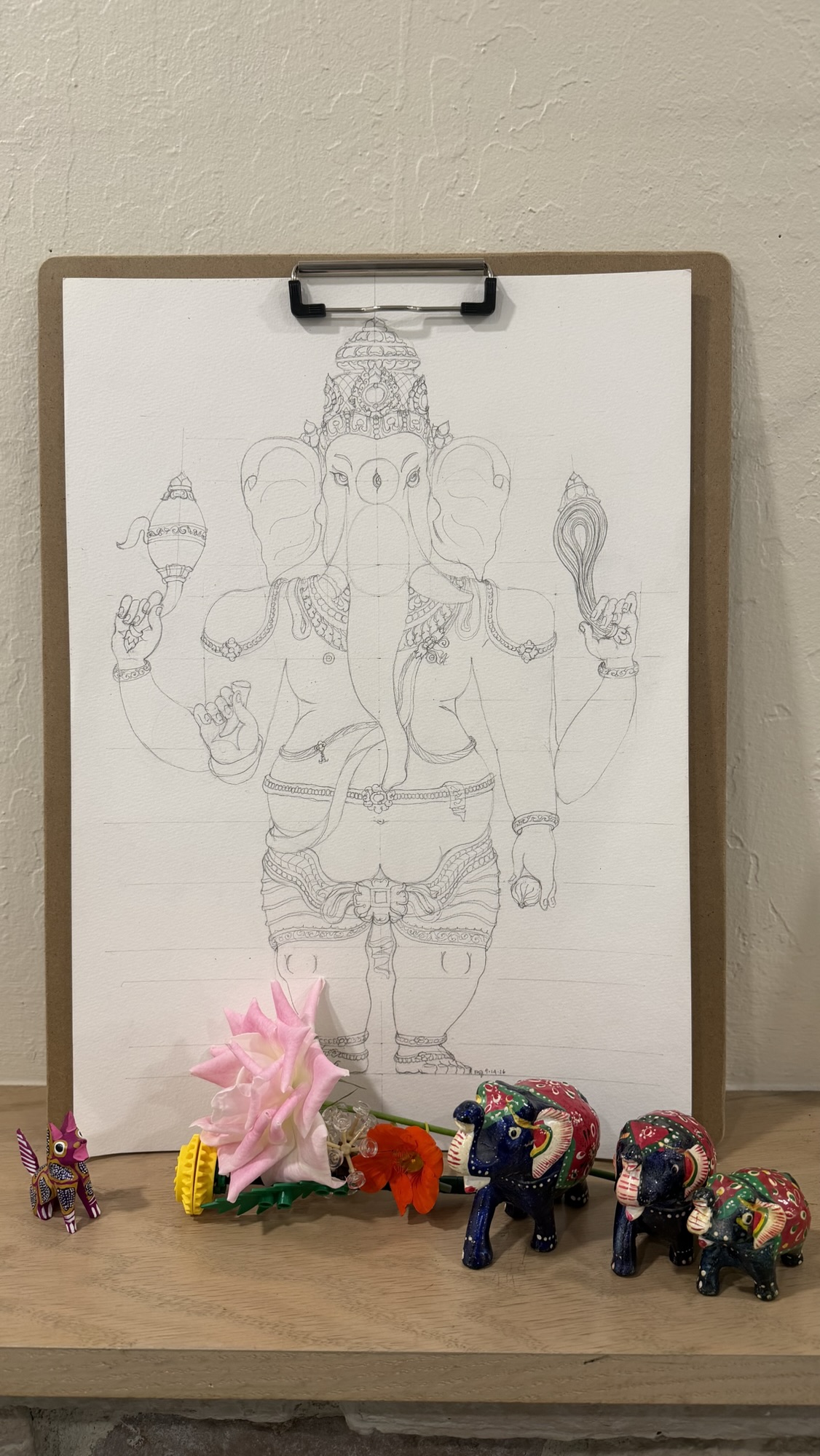
Today, Ganesha takes center stage—the protector, remover of obstacles, and the gentle giant.

This celebration also offers an opportunity to share a glimpse of a Panchatala Ganesha drawing, learned as part of a Shilpa Shastra curriculum under the guidance of my Guru Drdha of Divyakala Studio in Udupi. There is something remarkable about sitting in California and learning a traditional Indian knowledge system from a teacher in Udupi, India. Distance becomes almost irrelevant when knowledge, practice, and dedication can travel across continents.
That experience has also prompted a larger reflection on architectural education.
During the five years of my architectural education at RVCE in Bangalore, traditional Indian art and architecture received remarkably little attention. There was no meaningful space dedicated to understanding the systems of design, proportion, symbolism, craft, or spatial knowledge that had evolved across the subcontinent over centuries.
Instead, architectural education largely looked outward—to Western architectural history, theories, movements, and design paradigms. These traditions are undoubtedly valuable, but the imbalance raises an important question: What happens when an education system teaches students to look everywhere except at the cultural landscape they inhabit?
India already possesses extraordinarily sophisticated bodies of knowledge. The Shilpa Shastras, Vastu traditions, vernacular building practices, crafts, temple architecture, settlement patterns, and community-based knowledge systems offer ways of understanding not only buildings, but also materials, climate, proportion, ritual, ecology, making, and place.
The challenge is not to reject contemporary or Western architectural thought. It is to create a more complete architectural education—one in which Indian traditions are studied with the same seriousness, curiosity, and intellectual rigor.
Today, that learning happens independently, for a few hours each week: drawing, studying, practicing, and slowly beginning to understand a knowledge system that was largely absent from formal architectural education.
Perhaps that is where preservation begins—not simply by placing traditional architecture behind glass, but by learning it, practicing it, questioning it, and allowing it to evolve.
Architectural education and policy in India have an opportunity to bring these worlds together. Vernacular architecture, community development, contemporary planning, classical arts, craft, and traditional architectural knowledge do not have to exist in separate silos. They can inform one another.
Much of this knowledge has already been documented in the shastras. The opportunity now is to bring it back into active learning and practice.
Because preserving a tradition does not necessarily mean keeping it unchanged.
Sometimes, preservation begins by learning to see what was already there.
Leave a Reply